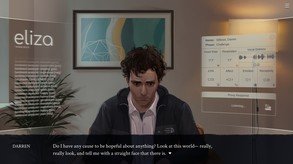
Eliza is a mature and contemplative visual novel that explores artificial intelligence, mental health, corporate technology, privacy, and the complicated boundary between genuine human empathy and automated assistance. Developed and published by Zachtronics, it takes a remarkably restrained approach to subjects that could easily have been turned into exaggerated science fiction. Instead of presenting AI through robots or futuristic disasters, the story examines a technology that feels disturbingly plausible: an automated counseling program that determines what should be said to vulnerable clients while a human proxy delivers those words in person.
The story centers on Evelyn Ishino-Aubrey, a former technology professional returning to society after spending several years away from her previous career and social circle. She takes a job working for Eliza, an AI counseling service where her responsibility is not to provide her own advice but to repeat responses generated by the system. This creates one of the game's most effective sources of tension. Evelyn is physically present with people discussing deeply personal problems, yet the software controls what she says. The arrangement forces her to confront uncomfortable questions about whether empathy can be standardized and whether a human intermediary provides meaningful connection when that person's actual thoughts are excluded from the conversation.
The counseling sessions give the story much of its emotional strength. Clients arrive with different personalities, circumstances, and concerns, preventing the technology debate from remaining purely theoretical. Some interactions demonstrate why an accessible automated counseling system could be valuable, particularly for people who might otherwise struggle to obtain support. Others expose the limitations and ethical concerns of allowing algorithms and corporations into intensely private areas of people's lives. Eliza avoids making the technology completely benevolent or obviously malicious, allowing its advantages and dangers to exist simultaneously.
Evelyn's personal journey gradually becomes just as important as the counseling program itself. Her previous involvement with the technology industry connects her to people with very different attitudes toward ambition, innovation, responsibility, and success. Conversations with former colleagues and acquaintances slowly reveal more about her past and why she abandoned the life she once had. The resulting story is therefore not merely an argument about artificial intelligence. It is also about burnout, purpose, friendship, personal responsibility, and deciding what constitutes a worthwhile life after professional success stops providing fulfillment.
Gameplay follows the traditional visual novel structure, so reading, listening, and making occasional decisions form the majority of the experience. Players expecting exploration, combat, elaborate puzzles, or complex simulation systems should adjust their expectations accordingly. During many counseling sessions, Evelyn must follow the AI-generated script, deliberately restricting player freedom. That limitation works thematically because it recreates Evelyn's lack of control. More significant choices emerge as her personal story progresses, eventually allowing the player to influence how she approaches her future.
The game also includes Kabufuda Solitaire, a card-game diversion that provides a welcome mechanical break from lengthy conversations. It is a relatively small addition, but it fits surprisingly well within an otherwise dialogue-heavy experience. After several emotionally demanding scenes, having something straightforward and interactive available helps vary the pacing without undermining the narrative.
Visually, Eliza uses attractive hand-painted artwork to portray Seattle and its inhabitants. The locations remain grounded in contemporary reality rather than adopting an excessively futuristic aesthetic, strengthening the idea that the ethical issues being discussed belong to the present or near future. Character illustrations are expressive without becoming overly dramatic, while backgrounds create a calm, occasionally melancholic atmosphere appropriate for Evelyn's introspective journey.
The extensive voice acting is another major strength. Hearing characters speak gives the counseling scenes additional emotional impact, especially when a distressed client receives a carefully constructed but impersonal response from the Eliza system. Vocal performances communicate hesitation, frustration, uncertainty, and vulnerability in ways that complement the written dialogue. The ambient soundtrack works similarly well, remaining understated enough that it rarely competes with conversations while reinforcing the reflective tone.
One of Eliza's most successful qualities is its refusal to provide simplistic answers. Automated counseling can appear unsettling because personal information is being processed through a corporate technological system, yet the game also recognizes the potential benefits of inexpensive and accessible assistance. It raises questions about data ownership, commercialization, professional responsibility, algorithmic decision-making, and whether simulated empathy can provide genuine comfort. Rather than instructing players what conclusion to reach, it presents conflicting perspectives and allows Evelyn's experiences to make those questions increasingly personal.
The main drawback is that the experience depends heavily on the player's tolerance for slow, conversation-driven storytelling. There are long stretches with minimal conventional interaction, and anyone expecting a dramatic cyberpunk thriller may find the restrained presentation uneventful. Choices also do not transform every scene into a radically different storyline. This is fundamentally a narrative experience where character development and ideas matter more than mechanical complexity.
Steam Deck users should consider the game playable rather than assume a completely optimized handheld experience. Compatibility information indicates that it can run on Steam Deck, but it should not be treated as equivalent to an official Steam Deck Verified designation. Its relatively straightforward mechanics make handheld play feasible, although occasional adjustments or minor interface inconveniences may be possible. Players specifically buying or installing games for Deck use should therefore expect functional compatibility rather than guaranteed console-like optimization.
Eliza ultimately succeeds because its discussion of artificial intelligence remains anchored to believable human problems. It asks whether efficiency can substitute for understanding, whether technology companies should mediate emotional relationships, and how individuals find meaning when their careers and ideals no longer align. Combined with strong writing, polished artwork, excellent voice performances, atmospheric music, and a memorable protagonist, it delivers a thoughtful experience that remains particularly relevant as automated systems become increasingly integrated into everyday life.
Rating: 9/10