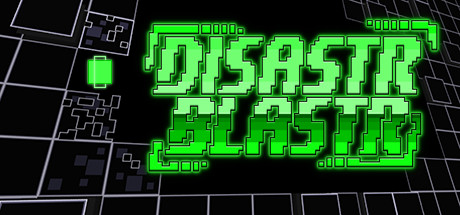
Disastr_Blastr is a focused arcade shooter built around speed, reflexes, unpredictable encounters, and the pursuit of increasingly impressive scores. Developed and published by Dog Theory, it avoids elaborate storytelling and complicated progression systems in favor of a straightforward challenge: enter an abstract battlefield, destroy hostile entities, survive the resulting chaos, and keep pushing forward. Its minimalist geometric appearance might initially make the experience seem simple, but underneath that restrained presentation is a demanding action game that constantly tests movement, situational awareness, and the player's ability to react when an encounter refuses to unfold exactly as expected.
One of its defining qualities is the expansive non-linear structure containing more than 100 stages. Rather than feeling like a short succession of isolated shooting arenas, progression takes place across a larger interconnected collection of challenges. The non-linear approach provides some freedom in how players tackle the experience and makes advancement feel more substantial than simply clearing one numbered stage after another. Individual areas remain mechanically straightforward, yet their quantity and organization give the game enough room to steadily increase pressure while introducing new combinations of hazards and opponents.
Randomness is fundamental to the design. Stages are intended to behave differently between attempts, meaning memorization alone cannot completely solve the game. Familiarity certainly helps, particularly when learning how enemies move and how weapons behave, but players still need to react to whatever combination of threats develops during a run. This unpredictability gives repeated attempts more purpose and makes successful runs feel earned. The downside is that players who strongly prefer carefully scripted encounters may occasionally find the randomized nature of the action frustrating, especially when several dangerous situations emerge simultaneously.
Enemy interactions make that unpredictability considerably more interesting. Opponents possess abilities that can combine with those of other enemies, creating emergent situations that become more dangerous than each individual threat would be on its own. As a result, target prioritization matters. Destroying the wrong opponent first can leave the player trapped in an increasingly difficult situation, while quickly identifying the most disruptive enemy can restore control. This produces a satisfying rhythm in which apparently manageable battles can suddenly become frantic, forcing rapid decisions instead of allowing players to rely entirely on a predetermined strategy.
Combat is closely tied to score chasing. The game's destructive weaponry is not merely intended to clear the screen; it also allows players to create chain combos and pursue higher scores. This encourages an aggressive style of play because eliminating targets efficiently can be more rewarding than simply surviving cautiously. Newcomers can concentrate on staying alive and understanding enemy behavior, while experienced players have an additional objective in optimizing their attacks and maintaining combinations. Steam leaderboards complement this design particularly well, providing competitive motivation for anyone interested in mastering the scoring system rather than simply reaching the end.
Boss battles provide important milestones throughout the experience. Defeating these larger threats eventually unlocks particularly difficult multi-boss duels, where several dangers must be managed at once. These encounters bring together the central mechanics of Disastr_Blastr: constant movement, quick reactions, threat prioritization, efficient shooting, and adaptation. Fighting multiple bosses naturally intensifies the game's chaotic qualities, but it also gives skilled players opportunities to demonstrate how well they understand its movement and combat systems.
The presentation embraces abstraction rather than visual complexity. Cubic shapes, geometric environments, bright effects, and minimalist imagery keep attention centered on immediate threats and movement. It is a style that fits the gameplay because excessive environmental detail could make an already hectic battlefield harder to read. At the same time, the deliberately sparse aesthetic will not appeal to everyone. Players wanting elaborate environments, detailed characters, cinematic storytelling, or a strong narrative atmosphere are unlikely to find those qualities here. Disastr_Blastr instead treats visual simplicity as part of its arcade identity.
The original soundtrack by techno composer Joey Schmidt is another important part of that identity. Hypnotic electronic beats complement the speed and abstract imagery, creating a suitably energetic background for repeated destruction and frantic evasive movement. During particularly intense encounters, the combination of electronic music, rapidly moving objects, explosions, and continuous shooting can give the game an almost rhythmic quality. The soundtrack therefore contributes more than simple background music, helping establish the unusual atmosphere surrounding the otherwise stripped-down presentation.
Replay value comes largely from improving personal performance rather than collecting enormous amounts of conventional content. There are 39 Steam achievements alongside leaderboards, trading cards, and the extensive selection of stages. Players interested in achievements and score optimization therefore have additional reasons to revisit previously completed challenges. This is important because the fundamental combat loop remains deliberately consistent. Someone interested only in seeing each stage once may eventually encounter repetition, whereas players who enjoy perfecting arcade mechanics are more likely to appreciate the structure.
Steam Deck compatibility requires some qualification. The Steam store page does not currently display an official Valve Steam Deck compatibility rating for Disastr_Blastr, so it should not be described as officially Verified or Playable. The store page lists it as a Windows game, and anyone intending to play it on Steam Deck should therefore treat Deck operation as potentially dependent on Proton compatibility and individual configuration. Its twin-stick shooter design is conceptually well suited to handheld controls, but without an official Deck rating, compatibility should not be guaranteed.
Ultimately, Disastr_Blastr is most successful when approached as a concentrated arcade challenge rather than a conventional action adventure. Its combination of more than 100 stages, non-linear progression, randomized encounters, interacting enemy abilities, destructive weapons, chain combos, demanding bosses, multi-boss battles, achievements, leaderboards, and energetic techno music gives the minimalist concept surprising substance. Randomness can occasionally produce frustrating situations and the abstract presentation limits its appeal for players seeking narrative or visual spectacle, but the core design remains engaging for anyone who enjoys mastering fast, demanding shooters.
It is a distinctive and energetic indie arcade shooter whose modest presentation conceals a substantial emphasis on skill, improvisation, scoring, and repeated mastery.
Rating: 8/10