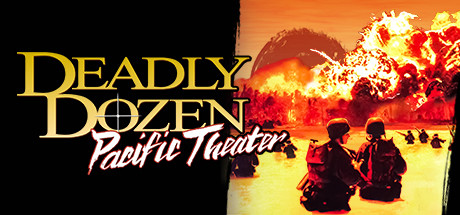
Deadly Dozen: Pacific Theater, developed by N-Fusion Interactive and brought to modern storefronts by Ziggurat, is a distinctive artifact from an era when tactical shooters existed in a space between full simulation and traditional run-and-gun design. Released at a time when most World War II games focused on the European front and leaned heavily into cinematic spectacle, Pacific Theater shifted attention to the often-underrepresented Pacific campaign and embraced a far more methodical structure. Rather than placing players in the boots of a single unstoppable soldier, it asks them to think like a field commander—assembling a four-man squad from a roster of twelve specialists and guiding them through missions where preparation, patience, and coordinated execution matter just as much as shooting accuracy. The game’s framing remains minimal, offering mission briefings and historical context without attempting grand storytelling, but this simplicity complements its grounded, boots-on-the-ground identity.
Every mission begins before deployment, with squad selection functioning as a strategic puzzle in itself. Each soldier brings distinct strengths—snipers excel in jungle overwatch positions, engineers handle explosives and mechanical sabotage, medics sustain survivability, and heavy weapons specialists provide vital suppressive fire. Choosing the wrong combination can turn a mission into a desperate scramble, while a well-balanced team transforms the battlefield into a canvas for tactical improvisation. Once deployed, players can switch freely between squadmates or issue commands, allowing them to execute multi-angle assaults, ambush patrols, or maintain stealth until engagement becomes unavoidable. Combat is intentionally unforgiving—ammunition is limited, visibility is often obstructed by dense foliage, and even a single exposed movement can bring overwhelming enemy fire. The resulting tension gives each encounter weight, making progress feel earned rather than scripted.
The Pacific setting plays a crucial role in shaping the experience. Missions unfold across rain-soaked jungle trails, fortified island installations, cliffside gun emplacements, occupied villages, and hidden coastal outposts. Terrain is not simply decoration—it dictates tactics. Thick vegetation allows for stealth and flanking, open beaches punish reckless movement, and elevation differences turn snipers into decisive assets. Objectives vary enough to maintain momentum, ranging from disabling communication lines and rescuing prisoners to destroying supply depots or infiltrating enemy bases. The game’s pacing encourages players to scout, plan, and adapt, reinforcing the idea that American commandos operating behind enemy lines must rely on intellect and coordination rather than overwhelming firepower. Even with dated AI and environmental detail, the atmosphere remains tense and immersive because the stakes are constantly felt at a mechanical level.
Technically and visually, Pacific Theater reflects its early-2000s origins. Character animations are stiff, texture work is simplistic, and environmental geometry can appear sparse by modern standards. Yet the presentation still communicates place and purpose—sunlight piercing through jungle canopies, rusting metal barrels stacked near temporary encampments, camouflaged bunkers tucked into cliffsides. The overall aesthetic prioritizes clarity over gloss, which proves beneficial during firefights where quick visual interpretation is essential. Sound design—realistic gun reports, ambient wildlife, distant artillery—quietly reinforces immersion without overwhelming the senses, and the absence of a dramatic score gives combat a grounded, unnerving quiet. The remastered Steam release improves compatibility, resolution options, and stability, but it does not attempt a full modernization, preserving the original’s rough edges and understated charm.
However, the game is not free of frustrations. Companion AI frequently struggles with pathfinding, sometimes failing to navigate tight spaces or position effectively during engagements. Issuing commands can feel clunky, especially under pressure, and occasional difficulty spikes may force players into repetitive trial-and-error. Limited save functionality in the original design could amplify mission stress, though modern updates have softened this. Enemy behavior, while dangerous, lacks sophistication, often relying on sheer numbers and accuracy rather than varied tactics. Players expecting contemporary polish, fluid movement, or dynamic battlefield systems may find the game archaic. Yet these flaws also underscore its identity as a tactical shooter built during a different design era—one that valued vulnerability, deliberation, and improvisation over spectacle.
The enduring appeal of Deadly Dozen: Pacific Theater lies in its sincerity and its willingness to trust the player. It does not guide, funnel, or heavily script; instead, it provides tools, objectives, and landscapes, then lets players determine how to survive. This freedom—combined with the squad-building element—gives the game replay value long after its campaign ends, encouraging experimentation with different team compositions and tactical philosophies. In a modern gaming landscape filled with polished but highly directed shooters, Pacific Theater feels refreshingly hands-off. It invites players to slow down, observe, and approach violence as a problem to be solved rather than a spectacle to rush through.
For those who enjoy retro tactical shooters, historically themed strategy-action hybrids, or underappreciated World War II titles, the Steam release offers an opportunity to rediscover—or experience for the first time—a game that might otherwise have vanished into obscurity. It may not match the technical sophistication of contemporary releases, but its structure, pacing, and philosophy still resonate. Deadly Dozen: Pacific Theater remains a thoughtful, challenging, and atmospheric representation of squad-based warfare, proving that tension and satisfaction do not require cinematic presentation—only a well-designed mission, a carefully chosen squad, and the courage to step into the jungle knowing a single misstep may be your last.
Rating: 7/10