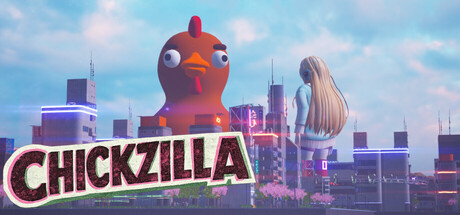
Chickzilla is an unapologetically silly destruction game that turns the familiar giant-monster formula into a colorful arcade-style power fantasy. Developed by Surin and published by Devotion Interactıve, it puts players in control of oversized creatures whose primary purpose is to demolish an urban environment as efficiently as possible. Rather than relying on a complicated story or lengthy introduction, the game builds its identity around a straightforward cycle of destruction, growth, and increasingly spectacular devastation.
The central mechanic is based on becoming stronger through destruction. Players begin as a comparatively modest menace, capable of attacking smaller structures and objects scattered throughout the city. Every successful act of destruction contributes to the creature's growth, gradually transforming it from an urban nuisance into something resembling a full-scale natural disaster. This creates an entertaining sense of progression because the player's increasing power is reflected directly in the environment. Structures that initially seem substantial eventually become minor obstacles, while skyscrapers become attainable targets once enough destruction has fueled the creature's evolution.
The choice of playable monsters adds to the intentionally ridiculous atmosphere. The roster includes unlikely giants such as an enormous chicken and a massive pig, turning what could have been a conventional kaiju concept into something far more comedic. The characters fit naturally with the bright, cartoon-like presentation, ensuring that demolishing an entire city feels more playful than sinister. There is little concern for realism here, and that works in the game's favor because its strongest moments come from embracing absurdity without attempting to justify it.
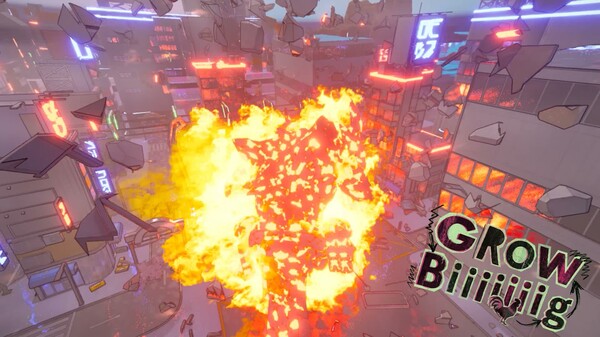
Environmental destruction is one of the most important elements of the experience. Buildings and urban objects are designed to break apart as the player tears through them, with materials such as glass, concrete, and structural components contributing to the spectacle. The physics-driven destruction gives attacks a more satisfying sense of impact than simply watching a building disappear after its health reaches zero. As the creature becomes larger, the difference in scale becomes particularly enjoyable because increasingly substantial structures can be smashed apart with less effort.
Chickzilla also avoids making enemy resistance the primary challenge. Military forces may attempt to stop the player's rampage, but the creature is presented as an overwhelming force rather than a fragile protagonist struggling to survive. This keeps the emphasis on destruction instead of defensive combat. Players expecting complex battles, elaborate enemy behavior, or demanding boss encounters may therefore find the combat side relatively lightweight, but that simplicity is consistent with the game's central fantasy of being nearly unstoppable.
The more significant opponent is time. The objective is not merely to destroy the city but to cause as much damage as possible before the available time expires. This gives the sandbox destruction a clear arcade structure and encourages players to think about efficiency. Choosing productive routes, targeting valuable structures, maintaining momentum, and reaching larger forms quickly can make the difference between an ordinary run and an impressive one. Leaderboard competition further supports this approach by giving score-focused players a reason to repeat runs and optimize their strategies.
This structure also defines the game's limitations. Anyone expecting an enormous open world filled with elaborate missions, character development, narrative choices, or extensive exploration should temper those expectations. The urban setting primarily functions as a playground for destruction. Its purpose is to provide objects and buildings that demonstrate the player's increasing scale and strength. The resulting gameplay is immediately understandable and suitable for short sessions, although players who require deep progression systems may find the core loop repetitive after its novelty begins to fade.
Visually, the colorful 3D presentation suits the premise well. Exaggerated characters and cartoon styling prevent the widespread destruction from becoming overly serious, while the third-person perspective provides a useful view of both the creature and its surroundings. More importantly, the visual presentation supports the progression mechanic: seeing the player's monster gradually dwarf objects that previously appeared enormous is an important part of communicating increasing power.
The game is designed as a single-player experience and includes full controller support, which is particularly appropriate for its straightforward third-person action. Its uncomplicated control concept should make it accessible to players looking for something they can quickly start without studying extensive mechanics. The combination of movement, destruction, growth, and score chasing makes it particularly suited to brief sessions where immediate entertainment matters more than a lengthy commitment.
Steam Deck compatibility requires a more cautious assessment. Chickzilla does not currently have an official Steam Deck Verified or Playable rating displayed for the game. It is officially listed for Windows, although full controller support is included. Therefore, it should currently be treated as Steam Deck compatibility unknown rather than confirmed compatible. Proton may potentially allow it to run, but without an official Deck classification, buyers specifically intending to play on Steam Deck should not interpret controller support alone as confirmation of reliable handheld performance.
Overall, Chickzilla succeeds most clearly when approached as a compact arcade destruction sandbox rather than a deep monster simulator. Its escalating growth mechanic provides a satisfying transition from attacking smaller targets to becoming powerful enough to tear through major buildings, while physics-based destruction helps make that progression visually rewarding. The ridiculous selection of giant creatures and colorful presentation give the experience personality, and the time limit prevents the sandbox from becoming completely aimless. Repetition and limited mechanical depth may reduce its longevity for some players, but those who enjoy destruction physics, score chasing, giant-monster power fantasies, and intentionally absurd indie games should find plenty of entertainment in its straightforward chaos.
Rating: 6/10