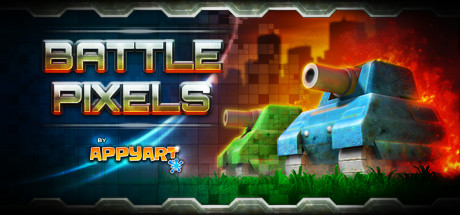
BATTLE PIXELS is a small-scale arcade action game that mixes tank combat with basic strategic management, creating an experience that feels different from a conventional top-down shooter. Developed by AppyArt Games and published by OtakuMaker.com, it approaches combat through a point-and-click control system rather than giving the player traditional direct movement. This decision gives the game its defining personality, since success depends not only on reacting to enemy attacks but also on managing the positions of several tanks while keeping track of dangers scattered across the battlefield. The result is an unusual combination of arcade intensity, casual accessibility, and light tactical decision-making.
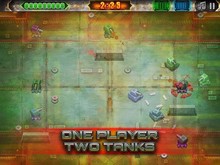
The main campaign consists of 25 randomly generated levels in which the objective revolves around commanding tanks and destroying hostile turret defenses. Procedural generation means that players cannot rely entirely on memorizing every battlefield, helping individual attempts feel somewhat less predictable. The fundamental mechanics remain straightforward, however. Tanks must be selected and directed toward appropriate positions while enemies attack and environmental dangers complicate movement. Instead of concentrating exclusively on aiming and shooting, the player is frequently concerned with where each unit should move and whether repositioning one tank will leave another exposed.
This point-and-click approach creates some genuinely hectic situations. Managing several units while projectiles and other threats are appearing can require considerable attention, and the game becomes increasingly demanding when multiple dangers need to be considered simultaneously. There is satisfaction in successfully coordinating tanks through a dangerous encounter, particularly when careful positioning allows the player to avoid attacks and eliminate defensive installations efficiently. At the same time, the controls can feel less immediate than the action demands. During faster encounters, issuing movement commands is not always as fluid as directly controlling a vehicle would have been. Consequently, some of the challenge comes from wrestling with the management system rather than purely overcoming enemy behavior.
BATTLE PIXELS attempts to keep its stages interesting through a collection of battlefield mechanics and hazards. Airstrikes, mines, guided missiles, defensive barriers, and conveyor belts can appear during play, changing how players approach movement and survival. Mines punish careless navigation, while guided attacks encourage constant repositioning. Barriers influence available routes and tactical opportunities, and conveyor belts can disrupt movement in ways that make otherwise simple situations more complicated. Airstrikes further increase the sense of chaos. These mechanics are valuable because the underlying combat loop is relatively narrow, so environmental complications become an important source of variety.
Progression is supported by a points and power-up system. Game points earned through play can be spent on abilities that provide additional assistance during later battles. This gives players an incentive to perform well beyond simply reaching the end of a level. The ability to continue or replay the previous game also makes repeated attempts less punishing than they might otherwise be. The progression system is not especially deep, but it complements the arcade structure effectively. It encourages players to improve their performance, experiment with available advantages, and push through increasingly troublesome encounters without introducing complicated role-playing or customization mechanics.
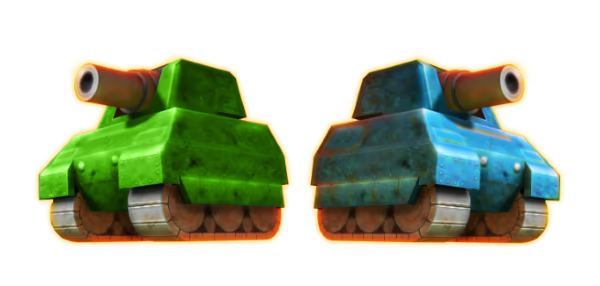
The visual presentation follows a colorful 16-bit-inspired pixel-art style. It is deliberately simple, emphasizing the appearance of an older arcade title rather than attempting realistic military imagery. Tanks, turrets, projectiles, explosions, and environmental hazards are generally easy to distinguish, which is especially useful when the battlefield becomes crowded. The retro graphics give the game a recognizable identity despite its modest production values. Players expecting elaborate animation or detailed environments will find the presentation limited, but the pixel aesthetic is appropriate for the fast, uncomplicated nature of the experience.
Sound contributes additional energy to the action. The game includes five soundtracks alongside effects for weapons, explosions, and other battlefield activity. Music helps establish the arcade atmosphere and gives momentum to encounters that could otherwise feel visually sparse. The audio presentation follows the same philosophy as the graphics: functional, energetic, and deliberately uncomplicated. Neither element attempts to compete with larger productions, but both support the game's retro personality effectively.
One of the main weaknesses is repetition. Random generation can rearrange circumstances, but it does not fundamentally change what players are doing. Much of the experience continues to revolve around directing tanks, avoiding incoming attacks, destroying defenses, accumulating points, and advancing to another battlefield. The additional hazards provide useful variations, yet they cannot completely disguise the limited number of core interactions. Players who enjoy repeating compact arcade challenges in pursuit of better performance may appreciate this structure, while anyone seeking extensive strategic depth, sophisticated enemy behavior, elaborate customization, or a substantial narrative is likely to find the experience comparatively thin.
The game's lightweight technical requirements reinforce its modest ambitions. BATTLE PIXELS was designed as a compact indie release rather than a demanding graphical showcase, and its tiny storage footprint reflects that philosophy. It is primarily concerned with delivering immediately understandable battles rather than cinematic presentation or large quantities of content. The single-player focus also means that commanding multiple tanks remains an individual management challenge instead of becoming a cooperative multiplayer concept. This keeps the experience focused but removes an avenue that could potentially have added longevity.
Ultimately, BATTLE PIXELS succeeds most when viewed as an experimental arcade game rather than a fully developed strategy title. Its combination of point-and-click tank management and shoot 'em up pressure is distinctive enough to separate it from countless straightforward retro shooters. Randomized stages, environmental hazards, power-ups, colorful pixel graphics, and energetic audio provide a respectable foundation, and coordinating several tanks can produce entertaining moments of controlled chaos. However, awkwardness in the control system and the repetitive nature of the fundamental gameplay prevent the concept from becoming consistently compelling.
For players interested in obscure indie titles, retro visuals, tank battles, and unconventional hybrids of strategy and arcade action, BATTLE PIXELS offers a curious experience that can be enjoyable in shorter sessions. Its ideas are more memorable than their execution, but there is charm in the game's willingness to experiment with familiar genres. AppyArt Games created a simple concept with enough hazards and progression to provide some variety, while publisher OtakuMaker.com presented it as the compact indie experience it fundamentally is. It is not particularly deep or polished, but its unusual mechanics and straightforward arcade personality give it a modest appeal.
Rating: 6/10