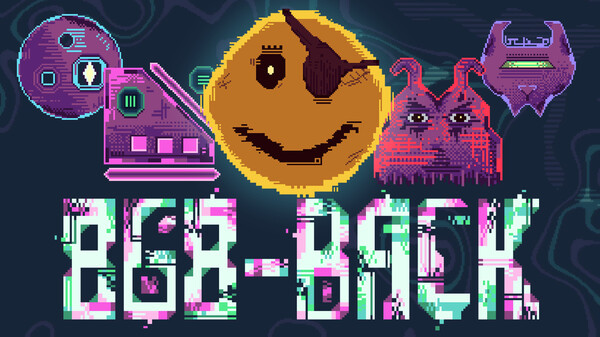
868-BACK is a computer-hacking strategy roguelike game where your mission is to dismantle capitalism one server at a time! Use hacking powers to fight enemies, steal the servers' data, and face increasingly nasty situations before being disconnected (again!) by the richest corporations on earth.
Modeled estimate, not a reported figure. How we estimate →
Prices
The United States storefront in every case, so this compares stores and not countries.
About
The Mainframe is lost, and you might be the only person still able to fight the MegaCorps. Lucky you! Your mission: dismantle capitalism one computer server at a time.
Data is currency, money, moola 🤑 The MegaCorps have too much info on me, you, and everyone. You’ll be taking it back. After all, progs aren’t cheap!
Progs are powers, and the MegaCorps control them all. You'll be stealing their code, and using it against them. Expect consequences.
You didn’t think the MegaCorps were going to let you reach the Mainframe without a fight, did you? The cyberstakes are high. Get disconnected too many times, and your mission starts from scratch.
The Big Three’s defenses are strong, Hacker, but you can be stronger. Pick up new tricks on every run, use the MegaCorps' progs to change the world, and find that Mainframe!
Genres
Stats
All-time low is the lowest price we've recorded for this game since we started tracking it.
Sums Steam only; GOG publishes no volume signal, so the true total is higher by an unknown amount.
| Store | Price | Audience | Score | Chart | Est. revenue |
|---|---|---|---|---|---|
SteamYou are here | $19.99 | 121reviews | 99% | — | $83.6K |
| $19.99 | 3ratings | 100% | — | not modelled |
Matched by title — a reused name can pair the wrong games. * is a critic aggregate. Prices and positions are each store's United States storefront; Epic charts worldwide. Audience and Score too, except Steam's, which is worldwide.
Engagement
Reviews
Themes across 72 recent reviews and how positive each mention is. A keyword signal, not full sentiment analysis.
Reviews
I'll just start out here by saying outright, this is not only the greatest roguelike I've ever played, but one of the best games I've ever played, period, and I've been gaming since the Atari 2600 era (born in '81, you see). In fact I think this might be my new all-time favorite. It's that good. Now, I'd had high expectations going into this one. I've played Michael Brough's games before, particularly 868-HACK and Cinco Paus, and have spent boatloads of time enjoying each (HACK primarily played on my iPad, Cinco Paus on PC). Over the years, I keep coming back to both. And I've dabbled into other games of his too. These were all brilliant. If this could be even close to how good those were, I thought, that'd be amazing. But this goes well past those. Part of what makes these games so good is the uniquely focused design. There will be a central concept, and absolutely everything about the game will orbit around that. The core mechanic is always simple and easy to understand. But how everything else spins around and connects to that core mechanic creates an endless array of puzzling situations, wild interactions that are surprising yet make total sense when you find them, and so on. In this game, that core mechanic works like this: You have these siphons (usually 2 per room, sometimes 3) that you can pick up and use. When used, they suck stuff out of the tile you're standing on, and every adjacent tile. If they hit a floor space, you get the resources displayed on that space. You use those resources to activate programs, which you siphon out of cubes (walls) that have those programs displayed on them (so you always know what you'll get). If you hit a cube with a big number on it, you'll get data (points). And every cube also has a red number on it, showing how many enemies will spawn when you siphon that cube. Each program has a value (the Refresh program for example always brings out 4 enemies), and for data, if it's 8 points, it's gonna summon 8 enemies. You'll then use the resources you yoinked out of the floor to power the programs you yoinked out of the cubes to fight the enemies that were summoned when you did the yoinking of the cubes. All with the goal of getting as much data as you can, and then escaping the 8th sector (room) of the server you're on. And combat is simple: you can move in 4 directions, if you move in the direction of an enemy, you shoot a beam at it instead of moving. You can also activate a program. That's it. Simple, yet it absolutely isnt. Other elements are also there, interacting with all of this. You have a big map of servers you'll uncover as you go, and each server has a passive item to get (which you get the moment you enter, you dont have to find it in some maze or something), and special bonuses (for the enemies, not for you) that affect conditions within the rooms of the server. The passive items are all about having even more screwball interactions with the stuff in the servers. Maybe one lets you push walls around (which could allow you to push them into spots where you could siphon like 3 of them at once, for a big risk to get big points). Another might give you a turn of doing double damage, each time you use any program that causes you to move as part of its effect. Which makes for yet another interaction involving the main concepts. The passive items (called "devs") are done differently from how most roguelikes do them, too. You'll have a build of them, sure, but unlike other games, they arent just always on. When you start a server, all the devs are inactive. As you enter a new sector, you'll first choose one of your devs to turn on; it will then remain on until the end of the server. Or you might choose to boost one that is already on instead of turning a different one on. This means that even though your items are constantly there, the decisions you make in how you use them... and which ones to use... change depending on whatever lunacy might be happening in the server. Maybe the room you just entered has few walls in it, a mostly open space, so perhaps it's time to turn on the dev you got earlier that gives you double damage when hitting an enemy at a long distance. Stuff like that. What really gets me about this is that it allows for an absolutely insane amount of different combinations and situations and such to do, but without bloating everything. In a lot of roguelikes, they sorta have everything and the kitchen sink too. Too many mechanics, so many in fact that the interfaces for the game in question is a mangled mess and you need to memorize like 30 hotkeys, and you'll find more and more screwy mechanics as you go, with complexity increased by just adding more, more, more. I've always found that very frustrating. It's like, okay, I dont know what this potion does, so I gotta dunk it in this weird shrine so that a mysterious god can fart on it and then I figure out which potion it is based on which enemies gag when they smell it. There's too much going on in just one small mechanic (identification, in this case). And there's just... so much of that. So many mechanics, too much of everything. Here? Siphon works on cubes. Cubes give you things and summon monsters. There's only 5 monster types (and trust me, that's enough). Programs and devs directly interact with those things in very simple, easy to understand ways. They dont come with like 500 mechanics of their own. Instead, the complexity occurs as a result of the arrangement of all of these elements. All happening on a grid that fits in one screen. And what confusion you will experience, instead of being like "how in the world was I supposed to know to shove the key up my nose?", here it's like "these things are arranged like THIS right now... how can I puzzle out a way to survive this?". You can only have 8 programs at once, so you'll have to work out how to use them in that unique situation. And there's no end to these puzzling situations. The game is definitely hard, but the difficulty is yet another thing that interacts with everything. Play defensively, dont go after too many points, you'll have less monsters. Take risks to get more stuff, you'll get more monsters, and that means things get darned tough. The difficulty spikes didnt happen because some god sneezed wrong. It happened because of decisions YOU made, servers you chose, cubes you chose, programs you chose, with effects that are absolutely communicated to you. Well... mostly. There are a few things that are going to be darned surprising when you see them the first time (just wait till you see "advanced graphics"). But never in a "geez I have to go to the wiki AGAIN" kind of way. All of this in a gorgeous style with some absolutely amazing sound design. Good golly do I love the anxiety-inducing music in the Megatron servers (no, not THAT Megatron). Or that calm yet distressing theme in the much too sterile Unified corporation servers. All in a world that I find interesting. A lot of games have big stories I cant remember later. But I aint gonna forget the Basilisk moment from this game, that one's gonna stick with me, I loved that. I have no complaints about this game. None. Heck, every time I think "well this dev doesnt seem very useful", I soon find that it is. Every time. And there's just... nothing negative for me to say here. I tried thinking of something, because my name is Misery and what's what you'd expect, but I've got nothing. Seriously, this game is a masterpiece of the highest tier. Stuff this good comes along like once a decade. It's a hard game with a tough road to mastery, but in the best way possible.

Media

Related
Related
Price dynamics, follower growth, revenue and sales trajectories with interactive tooltips
This and every other Pro feature is free until October 20, 2026. A free account is all it takes.
Languages: English
Hours played at review time, across 72 reviews with recorded playtime.
positive critical· bar length = how often the theme comes up
At 30 hours in, I've only begun to scratch at the surface of the game, but I feel safe calling it my favorite release of this year. It's a tightly-packed, intensely engaging puzzlebox of design, where no choice feels without weight and no feature is without unerring intent. You are always on the edge of a knife, never more than one mistake away from disaster, your obstacles machiavellian in their insurmountable simplicity. Every situation requires a brand new plan and reevaluation of your choices thus far, an endless balancing act where you juggle the comfort of relative safety, the power of immediate benefit, and the hunger for long-term gains; skill and luck will occasionally bestow a chance for two of those simultaneously, but you will never have the luxury of having all three. That all this agonizingly delicious complexity is packed in such a compact form, a "coffeebreak roguelike" so condensed that it doesn't even have a "wait a turn" button, is no less than a work of genius. The basic layer of the hacking gameplay would be varied and thoughtful enough to carry a game by itself, but the addition of the overarching "campaign" creates a texture and flow unlike anything I've played. Many games exist where you'll play through a long series of missions or battles, broken up by visits to a home base or overworld map where you prepare for the next one; this is the only game I've played where those two layers feel completely inseparable, and where neither is the inferior. They feed into each other seamlessly, and choices in one have an uncountable number of cascading effects on the other, without ever feeling like an overwhelming mess or a nightmare of logistics and micromanagement: there's only a few buttons to press, only a handful of options to choose from at a time, but with a ton of weight behind each choice made. With the sheer amount of complications and gameplay modifiers to encounter (each of which feels like a new game by itself, even before you start considering their endless possible combinations), the complexity of the puzzle box feels genuinely infinite. Traditional Roguelikes are a curious animal, as rare and colorful as they are harsh, their robust genes built upon the hobby-old foundations of meaningful resource management and methodical, thoughtful action within a complicated ecosystem. 868-BACK is an apex predator, a beast of absolute intent and purpose, honed by years of evolution to be as sharp, lean and vicious as possible. Don't be fooled by its humble size or its cute smiling face - this game is a killer, and beneath its fur you will find only muscle and claws.
Started playing 868-BACK, and oh my god. It feels like I've never really played a real roguelike before. Like the world knew only checkers, and then someone came and invented chess. This will probably be my new obsession...
I'm shocked to write this, because this game, on the face of it, does not seem like it is for me. I'm not a big roguelike guy. I tend to favor full-reset mechanics in physical/analog/board games. I had 868-BACK on my Wishlist for a long while, but it was more a curiosity than anything. Then, a few days ago, on a whim, I decided to try the demo. I was *instantly* hooked by the insane level of intricacy in the design. Now I can't stop thinking about it. The whole traditional roguelike genre opened up to me because of this game. I'm blown away by the depth, but moreso blown away by how that depth is wholly in control of the player. My first few runs, I played overly safe, picking just a few things each time to learn what they do, and now, nearly 20 hours later, I'm engaging the systems on a completely different level. I'm looking for efficiencies in how to push each level that much further than I did before. Certain skill combos become the "oh I can do whatever I want now," skills, where before it was all a mystery. And it just keeps going. System and mechanical interactions are still revealing themselves to me each run. Every single run I say "oh I didn't know that was an option, too." Hell, I just found a new build out of two abilities I was convinced were the worst in the game, and now I think the pair are the strongest combo I've found yet. It's truly an astounding game. The music haunts my dreams. The story is surprisingly affecting for a game I expected literally 0 story from. I implore you to get it.
An absolute triumph. Richly thematic, terrifically compelling, impossibly deep. Two nested progression loops: An inner loop of grid-based tactical combat and data exfiltration, where new abilities and scoring opportunities are measured by how much they jack up the risk. And then an outer loop of choosing servers to hack, permanent upgrades to grab, and when to risk the curse of a mega-corporation tracking you down. If you like turn-based tactical games or roguelikes, it doesn't get better than this.
i thought the other reviewers were glazing, because it wasn't clear to me what was so awesome about this game from the trailer well, a couple hours in i could tell this was worth the money. 40 hours in, i'm thinking it belongs in that sacred tier of roguelikes, with the spelunkys, spires, noitas, quds, etc it feels impossible at first, but your knowledge grows as you experiment with your tons of tools. it's one of those "wait, i could always have done that?" games, and it's filled with those moments. i'm still having epiphanies about how abilities interact lol. it's ♥♥♥♥♥♥♥ addicting and the music is stuck in my head
868-BACK is the best roguelike ever made. It's got all the things that made 868-HACK great: simple mechanics that combo in surprising ways, a delicious risk/reward scoring system, and a tendency to put you in deadly situations where you feel brilliant for surviving. But the new stuff, oh man. There is *so* much depth to the meta layer of how you explore the map, but the devices and server bonuses make each decision manageable, and every single detail is perfectly designed. It's the only roguelike I've ever played where no part of the progression is boring.
really clever well made puzzler. I always love a good coffee break roguelike
This hidden gem is an absolute master piece. It's a bit overwhelming in the beginning, but once you're used to its terminology it's deeply satisfying to play. There are a lot of secrets and ability interactions to discover and experiment with, and being curious is highly recommended since the game only gives you the most basic information about how abilities work. It also stands out how well it conveys its theme. In short, buy it. Thank me later.
I haven't written a real review in a while, but a couple of times in the past week or so I've closed my eyes and seen a grid of volts and creds, so I think it's appropriate here. 868-BACK is an interestingly structured game in that it is a short, compact roguelike into which a 15-game campaign has been carefully integrated to make a much larger strategy game. The smaller roguelike, which is essentially 868-HACK, this game's predecessor, is a straightforward roguelike in the most traditional sense. You, a hacker, move a smiley face around eight six-by-six sectors of a server ("floors" of a "dungeon", in another setting) with the goal of getting out alive with as much data ("points") as possible. Tasks ("enemies") get in your way—more and more as you progress through the server—and you must pick up progs ("spells" or "weapons") to eliminate them. The game I've described so far is a pretty good tactical puzzle in which, as more and more tasks show up, you have to think carefully about the progs and resources available (all progs cost the aforementioned creds and volts to run) to survive. A series of puzzles like this can get dry, though, and can run into a balancing problem in which, a given puzzle being either solvable or not, the difficulty flips very quickly from easy to impossible (see Into the Breach, which is also a good game). 868-HACK avoids this issue, transforming it instead into a constant stream of difficult, interesting, life-or-death choices, by making you decide what you think you can handle. Every point and prog is acquired by using a siphon (a resource otherwise used to pick up the volts and creds which power progs) on one of the walls, which will promptly transmit ("spawn") a number of tasks anywhere from a trivial one to a run-ending nine (sometimes walls are positioned so that you can even siphon multiple at once, which is a very efficient way to get lots of points and then lose them all). Enemies also show up on their own, but any mess you're in is one you thought you could handle. In this way, the tactical puzzles are interwoven with strategic choices, so that the result is a game in which everything rests on the quality of your decisions, but which is constantly tense and unpredictable. So much for 868-HACK, which is ~$6 elsewhere on Steam. 868-BACK takes the push-your-luck strategic element that ties the game together and amplifies it to an incredible degree. At the very beginning of the game, you're not pushed into a server; rather, you're presented with two and must choose one to hack. After you survive it (hopefully), it unlocks the four adjacent servers and you again make a choice, and again and again until you've hacked fifteen. Each server grants you a different dev (permanent upgrade) when you enter it, which is one important consideration. The best part, though—where this campaign and its decisions really transform 868-HACK into 868-BACK—is that each server has anywhere from one to five difficulty modifiers, which smugly call themselves bonuses, and each server gets a score multiplier which scales with the number of bonuses. The bonuses range from modifying the behavior of one enemy type to fundamentally changing how you interact with the game. Each one is uniquely devious, and each one demands respect, but the score multipliers are impossible to ignore. Now, you aren't just deciding within a server whether you have the resources, progs, and guts to siphon that 9-datacube, eliminate the nine enemies it will bring in, and also survive the huge wave of enemies in the next and final sector, you're deciding whether you should even enter a server with a x5 (!) score multiplier if it will have you vibe progging in an immersive world. Even better, once you make the ill-advised choice to enter the server, you can [i]also[/i] decide within it whether you should siphon that 9-datacube. This is just one facet of the decisions between servers. Some servers are corp servers, and of course the corps have mountains of juicy data and extraordinarily powerful devs—protected by their own bonuses and their own ways to permanently scar your run (this system in particular is really cool and does a great job of making the corps feel as scary as they should—it's kind of like if elites in Slay the Spire were scary not just as enemies but because they left curses in your deck, but that's not really doing it justice). Because of this system, along with the devs you get from each server and the scrip system that I won't bother going into, 868-BACK has a very satisfying progression in which your capabilities change as a run advances, and you do get stronger, but never in a way that makes the game flatter and less interesting. Another example of this that I love is specifically how the devs work—you start with none in each server and have to choose one to activate at the start of each sector, so that the devs aren't just a power bump, but another source of interesting strategy within the server runs. There are still more things that I haven't and probably shouldn't mention—to throw one in, the shops in this game are brilliantly done in a way very similar to the rest of the game. I'll mention one criticism: since the game is a string of smaller but not small games, a full campaign is pretty long, like eight hours, so it feels like a bit of a commitment. You can jump in half an hour at a time, but some of those half hours will feel pretty high stakes, being the culmination of many hours of prior play. I think there's a pretty significant upside to this, though, which is that the game manages to capture some of the satisfaction of having progression between runs without compromising any of a roguelike's essential quality of being purely skill- and knowledge-based. It's worth it, because the result of heaping this campaign on top of the tight, sharp smaller game is a perfect roguelike, in which every decision is transparent—everything is on a single screen and clearly readable—and impactful—has the potential to either end the run or yield a mountain of data—but which also contains the countless synergies and secrets that keep repeated runs exciting.
Selling now
See how fast this game is selling right now — estimated copies and revenue per day from recent review growth.
Players by region
Where this game's players are, estimated from review languages.
Related
| Game | Estimated lifetime revenue | Reviews | Review score | Price |
|---|---|---|---|---|
| $54.6K | 401 | 92% | $5.99 | |
| $8K | 22 | 95% | $14.99 | |
| $5.3K | 15 | 93% | $11.99 | |
| — | 0 | — | — | |
| $0 | 13 | 100% | Free | |
| $6.1M | 8.2K | 83% | $24.99 |
Related
| Game | Estimated lifetime revenue | Reviews | Review score | Price |
|---|---|---|---|---|
| $83.6K | 962 | 93% | $4.99 | |
| $83.5K | 196 | 73% | $7.99 | |
| $83.5K | 528 | 88% | $9.99 | |
| $83.5K | 123 | 67% | $19.99 | |
| $83.7K | 523 | 58% | $4.99 | |
| $83.5K | 192 | 78% | $14.99 |